
Paris Saint-Germain 4–2 FC Barcelona | UEFA Champions League 2026/27 | Matchday 3 | October 20, 2026
FC Barcelona suffered a disappointing 4–2 defeat against Paris Saint-Germain at the Parc des Princes on Tuesday evening, as Hansi Flick’s side paid the price for defensive vulnerabilities despite producing moments of attacking brilliance.
Goals from Xavi Espart and Lamine Yamal gave Barcelona reasons for optimism, but PSG demonstrated greater efficiency in decisive moments. Désiré Doué, Lucas Hernández, Vitinha and Fabián Ruiz scored for the French champions, who emerged victorious from an entertaining six-goal contest.
For Barcelona, the defeat raises important questions about defensive organisation, set-piece defending and the team’s ability to control matches against Europe’s strongest opponents.
However, the result also offered encouragement through Yamal’s individual brilliance, Espart’s breakthrough goal and the team’s determination to fight back twice.
PSG vs Barcelona: Match Summary
| Match Detail | Information |
|---|---|
| Competition | UEFA Champions League 2026/27 |
| Matchday | League Phase – Matchday 3 |
| Date | October 20, 2026 |
| Stadium | Parc des Princes, Paris |
| Final Score | PSG 4–2 Barcelona |
| Barcelona Manager | Hansi Flick |
| PSG Manager | Luis Enrique |
| Referee | Michael Oliver |
Goalscorers
Paris Saint-Germain
- Désiré Doué – 38′
- Lucas Hernández – 72′
- Vitinha – 81′
- Fabián Ruiz – 86′
FC Barcelona
- Xavi Espart – 55′
- Lamine Yamal – 79′
First Half: Barcelona Create Chances but PSG Strike First
The opening stages demonstrated why this fixture was among the most anticipated matches of the Champions League league phase.
Both teams attempted to impose their attacking identities, pressing aggressively and looking to exploit spaces between the opposition’s defensive lines.
Barcelona showed promising movement in possession, particularly through Pedri, Lamine Yamal and Raphinha.
The Catalans were capable of advancing into dangerous positions, but converting attacking possession into clear opportunities proved difficult.
Raphinha tested PSG goalkeeper Matvei Safonov, while Dani Olmo also threatened from distance.
At the opposite end, PSG’s technically gifted attackers created problems whenever Barcelona lost possession in dangerous areas.
The breakthrough arrived in the 38th minute.
Désiré Doué capitalised on an attacking opportunity to give the home side the lead, rewarding PSG’s pressure and exposing Barcelona’s difficulty in protecting vulnerable defensive spaces.
The goal changed the complexion of the contest.
Barcelona now needed to chase the game against an opponent particularly comfortable exploiting transitions.
Despite the setback, the visitors continued attempting to play through midfield rather than abandoning their possession-based approach.
Second Half: Espart Gives Barcelona Hope
Barcelona returned after the interval knowing that a more clinical performance was required.
Their response arrived in the 55th minute through an unlikely goalscorer.
Young defender Xavi Espart surged forward into space and produced a shot that beat Safonov, although the PSG goalkeeper could have dealt with the attempt more convincingly.
The equaliser was a significant personal moment for Espart, who registered his first Champions League goal.
More importantly, it restored Barcelona’s belief.
The goal demonstrated one of the advantages of Flick’s attacking system: players from deeper positions can contribute to offensive situations when opponents leave space.
However, Barcelona struggled to maintain the momentum generated by the equaliser.
Lucas Hernández Restores PSG’s Advantage
PSG regained the lead in the 72nd minute when Lucas Hernández scored with a powerful header from a corner.
The goal highlighted a familiar concern for Barcelona: defending the penalty area when opponents deliver dangerous balls into crowded spaces.
Barcelona had worked hard to recover from the opening goal, but a lapse in set-piece defending immediately placed them under pressure again.
Against opponents with PSG’s quality, such moments can determine the outcome of an entire match.
Lamine Yamal Produces a Moment of Magic
Barcelona’s response was spectacular.
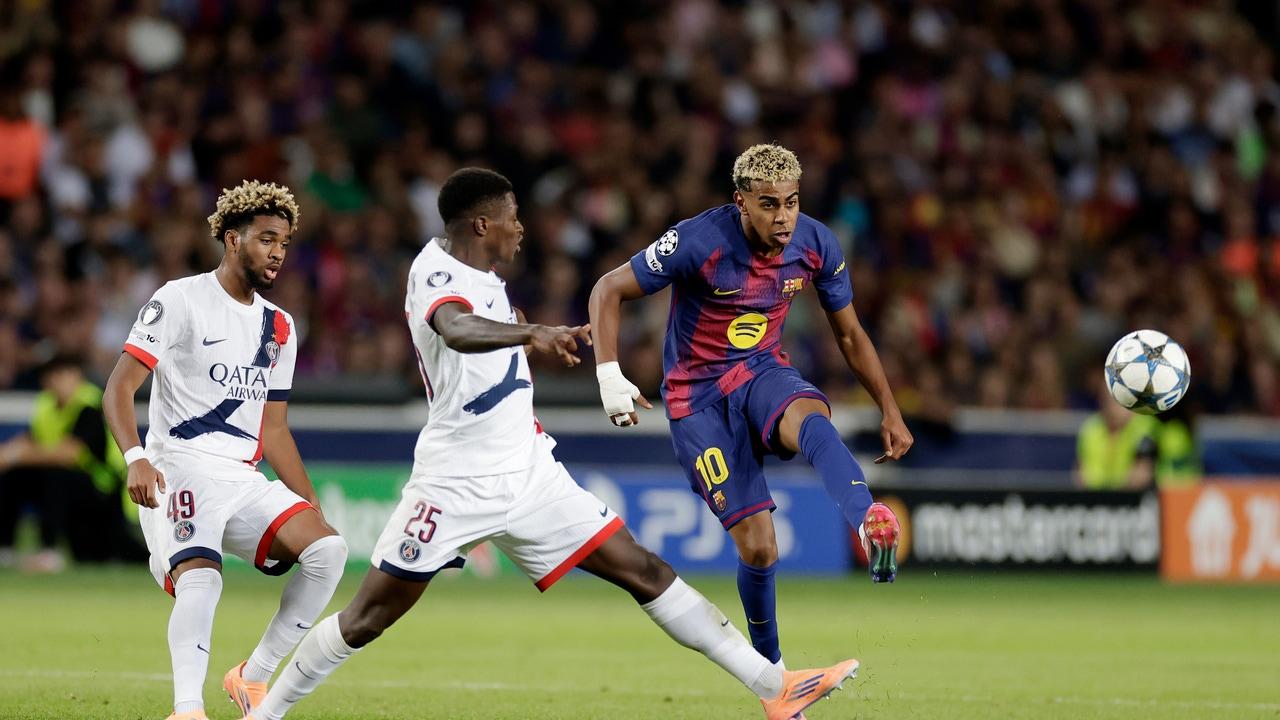
In the 79th minute, Lamine Yamal produced an outstanding individual goal to bring Barcelona level at 2–2.
Operating from the right flank, the youngster beat his opponent and found the net from a difficult angle with a brilliant finish.
It was precisely the type of individual intervention that makes Yamal one of Barcelona’s most important attacking players.
His confidence in one-on-one situations, ability to manipulate defenders and willingness to attempt difficult finishes provide Barcelona with a unique attacking dimension.
For a brief period, the momentum appeared to have shifted back towards the visitors.
Unfortunately, the celebrations were short-lived.
Vitinha and Fabián Ruiz Seal PSG’s Victory
Just two minutes after Yamal’s equaliser, Vitinha restored PSG’s lead.
The Portuguese midfielder struck in the 81st minute, giving Barcelona little time to reorganise after their dramatic comeback.
The goal represented a particularly damaging moment psychologically.
Having fought back twice, Barcelona immediately found themselves trailing again.
PSG completed the scoring in the 86th minute.
Achraf Hakimi delivered a dangerous ball across the penalty area, allowing Fabián Ruiz to finish from close range at the far post.
The fourth goal effectively ended Barcelona’s hopes of rescuing a result.
The final score of 4–2 reflected PSG’s greater efficiency in decisive attacking situations.
What the Numbers Tell Us
1. Barcelona conceded three second-half goals.
Despite recovering from a first-half deficit, Barcelona were unable to prevent PSG from repeatedly regaining control of the scoreboard.
2. Both teams scored after the 70th minute.
The closing stages were particularly chaotic, with four goals arriving from the 72nd minute onwards.
3. Barcelona twice equalised but never led.
This is one of the most revealing aspects of the encounter. Flick’s players showed resilience but failed to establish control after either equaliser.
4. PSG scored twice within five minutes late in the game.
Vitinha and Fabián Ruiz punished Barcelona during a period when the visitors were vulnerable defensively.
Barcelona Player Ratings vs PSG
VivaBarca editorial ratings, out of 10. These are subjective assessments of each player’s contribution, not official UEFA or Opta ratings.
| Player | Rating |
|---|---|
| Joan García | 8 |
| Xavi Espart | 8.5 |
| Pau Cubarsí | 7 |
| Gerard Martín | 6 |
| João Cancelo | 6 |
| Marc Bernal | 6 |
| Pedri | 7 |
| Dani Olmo | 6.0 |
| Lamine Yamal | 8.5 |
| Anthony Gordon | 5.5 |
| Raphinha | 6 |
| Fermín López | 6.0 |
Joan García – 8/10
A difficult evening for Barcelona’s goalkeeper.
Conceding four goals inevitably places the goalkeeper under scrutiny, although the defensive structure in front of him also contributed to the result.
García faced an opponent capable of generating dangerous opportunities from multiple attacking situations.
He could not prevent PSG from establishing control during the decisive closing stages.
Xavi Espart – 8.5/10
One of Barcelona’s most encouraging performers.
Espart demonstrated courage by advancing into an attacking position and scoring the equaliser early in the second half.
His willingness to contribute offensively provided an important breakthrough at a moment when Barcelona needed inspiration.
Although there are defensive lessons to take from the game, his goal represented a significant individual achievement.
Pau Cubarsí – 7/10
Cubarsí faced a demanding challenge against PSG’s movement and technical quality.
Barcelona’s defensive line was repeatedly tested by attackers capable of changing direction and exploiting small gaps.
The young defender showed his usual willingness to participate in build-up play, but the collective defensive performance was below the required standard.
Gerard Martín – 6/10
A challenging night for the defender.
PSG’s attacking movement created difficult situations for Barcelona’s back line, particularly when the visitors were forced to retreat quickly.
Martín was part of a defensive unit that struggled to remain compact throughout the contest.
João Cancelo – 6/10
Cancelo’s attacking instincts remain valuable, but Barcelona’s defensive balance was an issue.
When full-backs advance, the team must maintain adequate protection against transitions.
Against PSG, that balance was not consistently achieved.
Marc Bernal – 6/10
Bernal had a demanding responsibility in central midfield.
PSG’s ability to move the ball quickly and attack spaces placed considerable pressure on Barcelona’s midfield protection.
The match offered another example of the physical and tactical demands facing young players at Champions League level.
Pedri – 7/10
Pedri remained an important reference point in Barcelona’s possession game.
His composure, awareness and ability to receive the ball under pressure helped Barcelona construct attacking moves.
However, PSG’s intensity made it difficult for Barcelona to dominate midfield for sustained periods.
Pedri was one of the players who attempted to provide rhythm and control, even as the match became increasingly open.
Dani Olmo – 6/10
Olmo contributed to Barcelona’s attacking movement before his early departure.
He looked to operate between PSG’s defensive and midfield lines, providing an additional passing option in advanced areas.
His involvement was cut short, limiting his opportunity to influence the match.
Lamine Yamal – 8.5/10
Barcelona’s standout performer.
Yamal delivered another reminder of his exceptional individual quality.
His equaliser was the highlight of Barcelona’s attacking performance, combining technical skill, confidence and finishing ability.
Beyond the goal, his willingness to take responsibility in dangerous positions offered Barcelona a genuine attacking outlet.
While the defeat will dominate the headlines, Yamal’s performance provided another reason for optimism.
Anthony Gordon – 5.5/10
Gordon attempted to offer Barcelona pace and movement in attacking areas.
However, the overall attacking performance lacked the consistency required to put PSG under sustained pressure.
He also faced difficult defensive responsibilities as PSG pushed forward.
Raphinha – 6/10
The Brazilian was involved in Barcelona’s attacking play and tested the opposition goalkeeper.
His energy and movement provided useful options, but Barcelona needed greater efficiency in front of goal.
As one of the team’s experienced attacking players, Raphinha will be expected to play an important role in the response to this defeat.
Fermín López – 6/10
Introduced following Olmo’s departure, Fermín brought energy and movement into midfield.
He attempted to connect with Barcelona’s attackers and support the team’s efforts to recover possession.
His contribution came during a difficult and increasingly open contest.
Tactical Analysis: Why Barcelona Lost Against PSG
1. Defensive Transitions Remain a Concern
One of Barcelona’s biggest tactical challenges was maintaining defensive stability when possession changed hands.
Flick’s system encourages aggressive positioning, with defenders pushing forward and midfielders supporting attacks.
This approach can overwhelm opponents when Barcelona dominate the ball.
However, it becomes dangerous when possession is lost without sufficient defensive cover.
PSG possess the technical quality and movement to exploit those situations.
The challenge for Barcelona is not necessarily to abandon their attacking philosophy, but to improve their positioning before possession is lost.
2. Set-Piece Defending Must Improve
Lucas Hernández’s goal exposed an important weakness.
Barcelona conceded from a corner at a crucial moment, allowing PSG to regain the lead after the visitors had worked hard to equalise.
Set-piece defending requires coordinated marking, concentration and decisive aerial challenges.
Against elite European opponents, a single mistake can undo long periods of otherwise competitive football.
Barcelona must become more reliable in these situations.
3. Barcelona Could Not Control the Game After Scoring
Perhaps the most disappointing aspect of the performance was Barcelona’s inability to manage the moments immediately following their goals.
After Espart equalised, PSG eventually restored their lead.
After Yamal made it 2–2, Vitinha scored almost immediately.
This pattern suggests that Barcelona struggled to turn emotional momentum into tactical control.
When a team equalises away from home against a major opponent, the next few minutes are especially important.
Players must remain organised, avoid unnecessary risks and ensure the opposition cannot immediately regain momentum.
Barcelona failed to do that.
4. PSG Were More Ruthless
Barcelona demonstrated that they could hurt PSG.
The two goals were evidence of attacking quality, and there were other promising moments.
But PSG were more decisive when opportunities emerged.
Their ability to score through different players also made them difficult to contain.
Doué provided the opening goal, Hernández scored from a set piece, Vitinha delivered a crucial late finish and Ruiz completed the victory.
That variety of goalscoring threats is one of the characteristics of a dangerous European side.
5. Lamine Yamal Cannot Carry the Attack Alone
Yamal’s equaliser was a magnificent moment, but Barcelona cannot rely on extraordinary individual brilliance to rescue difficult matches.
Against elite opponents, the entire attacking structure must function efficiently.
The midfield needs to create better conditions for the forwards, while the wide players and central attackers must provide consistent movement.
Yamal can decide matches with moments of genius.
However, Barcelona’s long-term success will depend on building a system that produces high-quality opportunities collectively.
Three Positive Lessons for Barcelona
Despite the disappointing result, there were encouraging elements.
First, the team demonstrated resilience. Barcelona equalised twice away from home against a major European opponent. That willingness to respond is important.
Second, young players continue to contribute. Espart’s Champions League goal illustrated how Barcelona’s emerging talent can influence important matches.
Third, Yamal remains a major difference-maker. His technical ability and confidence offer Barcelona an attacking weapon capable of changing the course of a match.
These positives do not erase the defensive problems, but they provide a foundation for improvement.
What Must Hansi Flick Change?
Barcelona’s next steps should focus on restoring balance without sacrificing the team’s attacking identity.
The defensive line must communicate more effectively when opponents transition into attack.
Midfielders need to provide stronger protection when the full-backs advance.
The team must also improve its defensive organisation at corners and free kicks.
Most importantly, Barcelona need to become more mature in their game management.
There are moments when slowing the tempo, retaining possession and limiting the opponent’s opportunities are more valuable than immediately searching for another goal.
Against PSG, Barcelona’s inability to manage those moments proved costly.
What Does the Defeat Mean for Barcelona’s Champions League Campaign?
The result represents a setback, but it does not determine Barcelona’s European future.
The Champions League league-phase format provides opportunities to recover from individual defeats.
However, every point matters when teams are competing for favourable positions in the overall standings.
Barcelona must respond by producing more balanced performances against their remaining opponents.
The defeat also serves as a warning about the standard required to compete with Europe’s strongest teams.
Attacking talent alone is not sufficient.
Champions League contenders need defensive consistency, tactical discipline and the ability to manage pressure.
Barcelona possess significant individual quality, but the performance in Paris showed that improvements are still necessary.
What’s Next for Barcelona?
Barcelona’s immediate attention turns back to domestic competition, including the highly anticipated El Clásico against Real Madrid.
That fixture will provide another major test of Flick’s side.
In the Champions League, Barcelona are scheduled to face Aston Villa at Spotify Camp Nou on November 3, 2026.
The home fixture offers an opportunity to recover from the disappointment in Paris and strengthen their position in the league phase.
For Flick and his players, the priority must be learning from the mistakes that allowed PSG to score four times.
Final Verdict: A Painful Defeat With Important Lessons
PSG’s 4–2 victory over Barcelona was an entertaining Champions League encounter, but one that exposed important weaknesses in the Catalan team’s performance.
Barcelona demonstrated attacking quality, resilience and individual brilliance.
Xavi Espart enjoyed a memorable European moment, while Lamine Yamal produced another outstanding goal.
Yet the positives were overshadowed by defensive mistakes, insufficient control and PSG’s clinical finishing.
The most worrying aspect was not simply conceding four goals.
It was Barcelona’s inability to protect the momentum created by their equalising goals.
Against opponents of PSG’s calibre, those moments can be decisive.
Hansi Flick now faces the challenge of turning this disappointment into a learning opportunity.
Barcelona have the talent to compete at the highest level, but they must become more organised, disciplined and consistent if they want to challenge for the Champions League title.
Final score: Paris Saint-Germain 4–2 FC Barcelona.
VivaBarca Verdict: Barcelona’s attacking potential remains exciting, but the defeat in Paris was a reminder that defensive stability and game management are essential ingredients for European success.