
VivaBarca.com | October 23, 2026 | La Liga Matchday 10
Nine league matches. Nine victories. Twenty-seven points.
Barcelona have made a flawless start to the 2026/27 La Liga campaign, but Sunday’s El Clásico against Real Madrid may be the first domestic fixture that truly tests the limits of Hansi Flick’s team.
The timing could hardly be more intriguing. Barcelona arrive at Spotify Camp Nou after losing 4–2 to Paris Saint-Germain in the Champions League, a result that interrupted their winning momentum and exposed questions about their defensive organisation.
Real Madrid, meanwhile, travel to Catalonia six points behind the leaders. José Mourinho’s team know that another defeat would turn an uncomfortable gap into a nine-point deficit after only ten rounds.
The stakes are therefore very different for the two sides. Barcelona have an opportunity to establish a commanding advantage over their greatest rivals. Madrid are fighting to prevent that advantage from becoming even larger.
But there is a deeper question beneath the league standings: can Barcelona maintain their attacking identity against an opponent specifically equipped to exploit the risks that come with it?
That question, rather than simply which team possesses the better individual players, could determine Sunday’s outcome.
1. Match Information: Everything Supporters Need to Know
| Detail | Information |
|---|---|
| Fixture | FC Barcelona vs Real Madrid |
| Competition | La Liga EA Sports 2026/27 |
| Matchday | 10 |
| Date | Sunday, October 25, 2026 |
| Kick-off in Barcelona | 9:00 PM CET |
| Saudi Arabia | 11:00 PM AST |
| UK | 8:00 PM GMT |
| United States (Eastern) | 4:00 PM EDT |
| Venue | Spotify Camp Nou |
| Barcelona coach | Hansi Flick |
| Real Madrid coach | José Mourinho |
2. The Title Race: Why Sunday’s Result Matters Beyond Three Points
The six-point gap makes Sunday’s Clásico unusually important for an October fixture.
Barcelona are not simply trying to protect first place. They have a chance to put their biggest rivals under substantial pressure before the season reaches its halfway stage.
How the result would change the gap:
- Barcelona win: Barça move nine points clear of Madrid.
- Draw: Barcelona preserve their six-point lead.
- Real Madrid win: Madrid reduce the deficit to three points.
A nine-point lead would not guarantee the title, particularly with more than two-thirds of the campaign remaining. Nevertheless, it would change the psychological landscape.
Madrid would be forced to chase, while Barcelona could approach future fixtures with a greater margin for error.
A Madrid victory would have the opposite effect. It would validate Mourinho’s recent improvements and place immediate pressure on Barcelona to respond.
This is why Sunday’s match could influence the title race long after the final whistle.
3. Recent Form: Barcelona’s Attacking Dominance Meets Madrid’s Recovery
Barcelona’s League Numbers Reveal Extraordinary Attacking Efficiency
Barcelona have scored 39 goals in their opening nine league matches, averaging 4.33 goals per game.
That figure illustrates just how difficult Flick’s team have been to contain domestically.
Their 5–2 victory against Real Betis and 3–0 win over Getafe are recent examples of a side capable of creating chances through multiple routes: wide combinations, central penetration, quick turnovers and movement inside the penalty area.
But their Champions League defeat to PSG provides a different perspective.
Barcelona’s 4–2 loss in Paris did not necessarily demonstrate that their entire system is flawed. It did, however, show how costly defensive vulnerabilities can become when opponents combine technical quality with speed.
Why the PSG Defeat Matters Tactically
Against a high-quality opponent, Barcelona cannot rely on scoring four or five goals to overcome defensive mistakes.
When both full-backs advance and midfielders commit themselves to attacking positions, Barcelona must maintain enough players behind the ball to defend against counterattacks.
If the first pressing line is bypassed, the opposition can immediately threaten the centre-backs.
This is precisely the type of situation Real Madrid may attempt to create.
The PSG defeat should therefore serve as a tactical warning rather than a reason to abandon Barcelona’s philosophy.
The solution is not necessarily to defend deeper. It may be to choose more carefully when to press, when to advance both full-backs and when to slow the game down.
Real Madrid’s Form: A Dangerous Opponent Despite the Gap
Madrid enter Sunday’s fixture having recovered momentum following an inconsistent start.
Their recent victories over Sevilla and RB Leipzig have demonstrated their ability to create goals and respond to setbacks.
Mbappé scored twice against Sevilla and has nine league goals entering Matchday 10.
However, Madrid’s attacking options have been affected by Vinícius Júnior’s suspension.
Without the Brazilian, Mourinho loses a player who can carry the ball over long distances, beat defenders individually and turn defensive recoveries into immediate attacking opportunities.
That absence could significantly change Madrid’s approach.
Rather than relying heavily on Vinícius to progress the ball down the left, Madrid may need more collective movement from their midfield and greater involvement from Bellingham, Güler and Mbappé.
4. Head-to-Head History: Barcelona’s Recent Advantage
| Date | Competition | Result |
|---|---|---|
| May 10, 2026 | La Liga | Barcelona 2–0 Real Madrid |
| January 11, 2026 | Spanish Super Cup | Barcelona 3–2 Real Madrid |
| October 26, 2025 | La Liga | Real Madrid 2–1 Barcelona |
| May 11, 2025 | La Liga | Barcelona 4–3 Real Madrid |
| April 26, 2025 | Copa del Rey | Barcelona 3–2 Real Madrid |
Barcelona have won four of these five meetings, scoring 12 goals and conceding nine.
The record is encouraging for Barcelona supporters, but the scorelines reveal something more interesting than simply which team won.
Three of Barcelona’s four victories came by a single goal.
That suggests the rivalry has frequently been decided by fine margins, even during periods when Barcelona have enjoyed the better results.
The 4–3 meeting in May 2025 illustrates the attacking possibilities of the fixture, while the 2–0 victory in May 2026 demonstrates Barcelona’s capacity to win with greater defensive control.
For Flick, the second example may provide the more useful blueprint.
Barcelona do not need to turn every Clásico into a seven-goal contest. A controlled performance that limits Madrid’s counterattacking opportunities could be more valuable than relentless attacking pressure.
5. Team News: Injuries, Suspensions and Selection Problems
Barcelona: Defensive Depth Is the Biggest Concern
Barcelona’s injury problems arrive at an unfortunate moment.
Dani Olmo is expected to miss the game following an adductor injury sustained against PSG. His absence removes a creative player who can operate between the lines, combine in tight spaces and arrive in scoring positions.
Eric García and Andreas Christensen are also unavailable, reducing Barcelona’s defensive options.
Jules Koundé’s ankle injury creates further uncertainty, although a return has not been ruled out.
Gerard Martín has recently returned from an ankle problem and could be required to play a significant role.
Raphinha’s return provides more encouraging news. The Brazilian started against PSG after recovering from a hamstring injury and could offer Barcelona an important combination of pressing intensity and attacking movement.
These availability details are based on pre-match injury reporting, with the final squad still subject to confirmation.
Projected Barcelona Lineup – 4-2-3-1
| Position | Player |
|---|---|
| Goalkeeper | Joan García |
| Right-back | Xavi Espart |
| Centre-back | Pau Cubarsí |
| Centre-back | Gerard Martín |
| Left-back | João Cancelo |
| Central midfield | Rodri |
| Central midfield | Pedri |
| Right wing | Lamine Yamal |
| Attacking midfield | Fermín López |
| Left wing | Anthony Gordon |
| Centre-forward | Raphinha |
This is an editorial projection based on reported availability, not a confirmed starting XI.
The most important question is how Barcelona will compensate for their defensive absences.
Cubarsí’s ability to read the game is valuable, but even an intelligent defender can struggle when forced to repeatedly defend large spaces against Mbappé.
If Koundé becomes available, Flick would gain additional flexibility in the back line.
In midfield, Fermín offers direct running, aggression and an ability to attack the penalty area, although his interpretation of the role differs from Olmo’s more combination-oriented approach.
Real Madrid: Vinícius Suspension Changes the Attacking Equation
Madrid’s most significant reported absence is Vinícius Júnior, who is suspended after his red card against Villarreal.
Rodrygo and Raúl Asencio are also listed among the absentees, while Ferland Mendy’s availability remains uncertain.
Vinícius’ suspension is especially important because it affects more than Madrid’s starting eleven.
His speed and dribbling often force opponents to defend deeper or leave additional cover on one side of the pitch.
Without him, Madrid may find it harder to stretch Barcelona’s defence horizontally.
However, Mourinho could compensate by placing more emphasis on central combinations and quick passes into Mbappé.
Projected Real Madrid Lineup – 4-2-3-1
| Position | Player |
|---|---|
| Goalkeeper | Thibaut Courtois |
| Right-back | Federico Valverde |
| Centre-back | Dean Huijsen |
| Centre-back | Ibrahima Konaté |
| Left-back | Marc Cucurella |
| Defensive midfield | Aurélien Tchouaméni |
| Central midfield | Arda Güler |
| Right wing | Endrick |
| Attacking midfield | Jude Bellingham |
| Left wing | Yan Diomande |
| Striker | Kylian Mbappé |
These lineups remain projections. Both managers may make adjustments before kick-off.
Potential bench roles, final medical clearances and suspensions should be checked against the official matchday squads.
6. Tactical Analysis: Five Battles That Could Decide El Clásico
The most interesting aspect of Sunday’s meeting is that Barcelona and Real Madrid may approach the match with fundamentally different priorities.
Barcelona will likely attempt to control possession, recover the ball quickly and create repeated attacking situations through their technical superiority.
Madrid may be more willing to accept periods without the ball, particularly if that allows them to attack the spaces Barcelona leave behind.
Neither strategy is automatically superior. The decisive factor will be how effectively each side executes its plan.
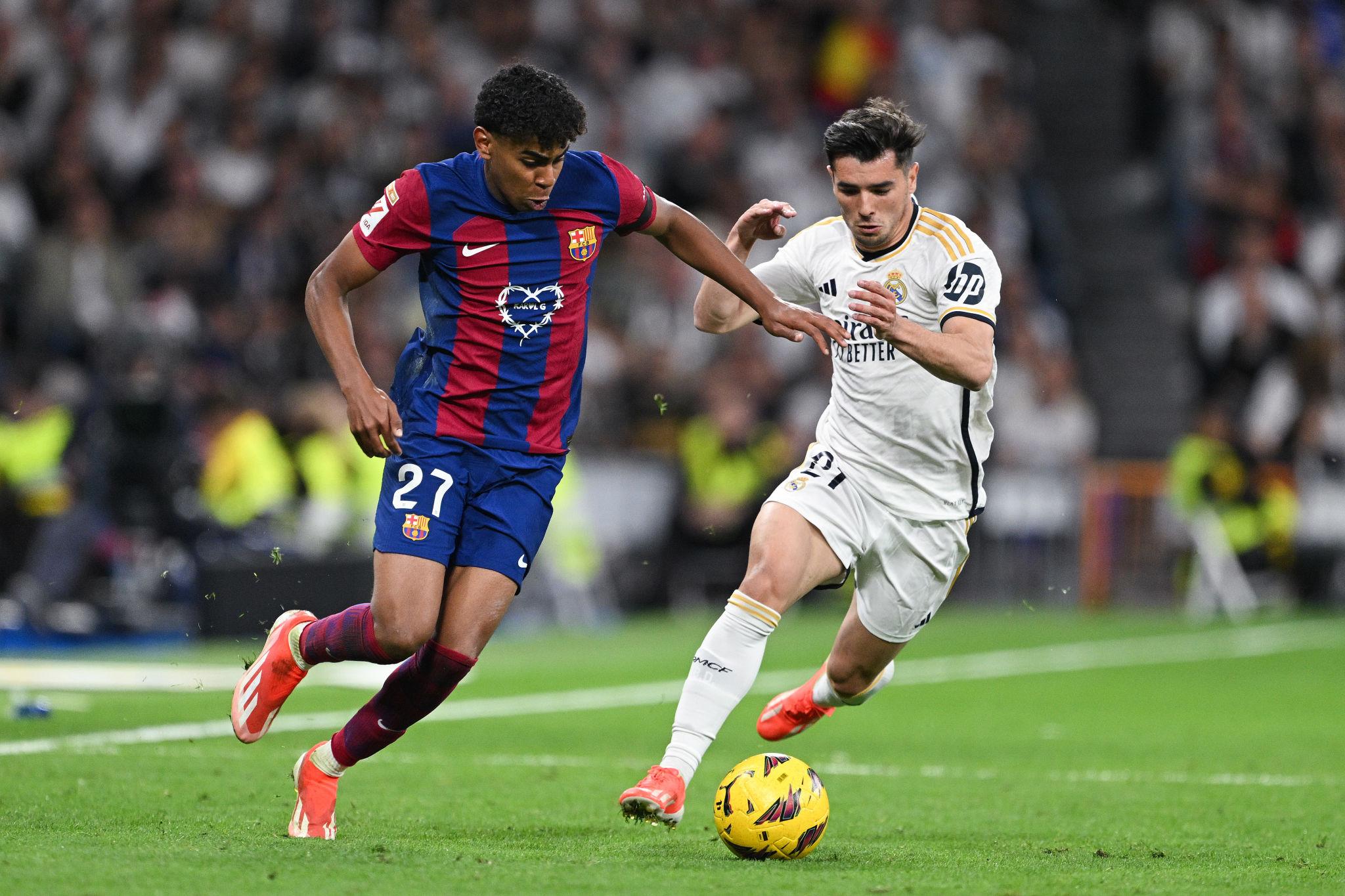
Battle One: Lamine Yamal Against Madrid’s Left Defensive Channel
Lamine Yamal has developed into one of Barcelona’s most influential attacking players.
According to the league figures cited in the preview, he enters the Clásico with eight goals, six assists and 32 chances created in La Liga.
Those numbers underline a crucial point: Yamal is not simply an exciting dribbler. He is already responsible for a substantial proportion of Barcelona’s attacking production.
Madrid must therefore decide how aggressively to defend him.
If Cucurella faces Yamal without additional support, the Barcelona winger could repeatedly create shooting opportunities or dangerous passes.
However, doubling up on Yamal creates other problems.
When a midfielder moves across to support the left-back, Madrid risk leaving space in central areas. Pedri or Fermín could exploit that space, particularly if Barcelona move the ball quickly.
What Barcelona should do: Rather than giving Yamal the ball in static positions and expecting him to beat two defenders, Barça should use quick combinations to isolate him against a single opponent.
Overlapping and underlapping runs from the right-back could also force Madrid’s defensive line to make difficult decisions.
Battle Two: Mbappé Against Barcelona’s High Defensive Line
This may be the single most important tactical battle of the match.
Mbappé has nine league goals and possesses the acceleration to exploit space behind an advanced defensive line.
Barcelona’s high line allows them to compress the pitch and recover possession close to the opposition’s goal.
However, the system becomes vulnerable when opponents escape the initial press.
Imagine a situation in which Barcelona have six players positioned ahead of the ball. Madrid regain possession and immediately play a forward pass into Mbappé’s path.
If Barcelona’s centre-backs are positioned near the halfway line without sufficient pressure on the passer, Mbappé may have the space to accelerate toward goal.
The danger is not simply that Barcelona defend high. It is that their defensive line could become disconnected from the midfield press.
What Barcelona should do: Maintain pressure on Madrid’s players receiving possession between the lines. If the ball carrier has time to look up, Barcelona’s defenders must be prepared to retreat rather than automatically holding their positions.
Flick should also consider keeping one full-back in a more conservative position when Barcelona attack.
That adjustment could reduce the space available for Madrid’s first counterattacking pass.
Battle Three: Pedri’s Control Against Madrid’s Midfield Pressure
Pedri’s contribution may be more important than any individual attacking highlight.
His greatest strength is not simply his passing accuracy. It is his ability to receive the ball under pressure, turn away from opponents and move Barcelona into more advantageous positions.
Against Madrid, the midfield battle could determine whether Barcelona attack through controlled combinations or become dependent on individual actions from their wingers.
If Mourinho instructs Bellingham or another midfielder to close Pedri aggressively, Barcelona will need alternative passing routes.
Rodri’s positioning could become especially important.
By dropping between or alongside the central defenders during build-up, he could create an additional passing option and force Madrid to decide whether to press higher.
If Madrid commit more players forward, Barcelona may gain space behind the first pressing line.
If Madrid remain compact, Pedri will need to find gaps through patient movement and quick combinations.
The decisive question: Can Barcelona move the ball through midfield without allowing Madrid to force turnovers in dangerous central positions?
Battle Four: Raphinha’s Pressing Against Madrid’s Build-Up
Raphinha’s return could be one of the most significant developments for Barcelona.
The Brazilian offers tactical value that extends well beyond goals and assists.
His pressing intensity can force defenders into hurried passes, while his movement without the ball can open spaces for teammates.
Against Madrid, Barcelona may attempt to direct possession toward one side before pressing aggressively.
For example, if Madrid circulate the ball toward their left-back, Raphinha and Barcelona’s midfielders could attempt to close the nearby passing options and force a turnover.
That approach would allow Barça to create chances without needing to build every attack from deep positions.
However, the press must be coordinated.
If Raphinha advances while the midfield remains too deep, Madrid could exploit the gap between Barcelona’s attacking and defensive units.
Flick must therefore ensure that the team presses collectively rather than through isolated individual efforts.
Battle Five: Bellingham’s Late Runs Into Barcelona’s Penalty Area
Jude Bellingham presents a different challenge from Mbappé.
While Mbappé threatens space behind defenders, Bellingham can arrive from deeper positions after defenders have already focused on the centre-forward.
That movement is particularly dangerous when the opposition’s midfielders fail to track runners.
If Barcelona’s central defenders become occupied with Mbappé, Bellingham could exploit the space around the edge of the penalty area.
The responsibility for tracking him may fall on Barcelona’s central midfielders.
This is where positional discipline becomes essential.
Barcelona cannot afford to have every midfielder moving toward the ball while leaving Bellingham unmarked.
A successful defensive performance will require communication between the midfield and back four, particularly when Madrid move the ball quickly into wide areas.
7. What Barcelona Must Learn From the PSG Defeat
Barcelona’s 4–2 defeat in Paris provides a useful reference point ahead of the Clásico.
However, Flick should resist the temptation to make dramatic changes based on one result.
The team’s attacking philosophy has produced nine consecutive league victories and 39 goals. Abandoning those principles could remove the qualities that make Barcelona so dangerous.
Instead, the focus should be on three targeted improvements.
Improve the Positioning Behind Attacking Moves
Barcelona need better protection against counterattacks.
When both full-backs move forward, at least one midfielder must remain positioned to disrupt potential transitions.
This is often described as rest defence: the structure a team maintains behind the ball while attacking.
An effective rest defence allows Barcelona to sustain pressure without leaving the central defenders exposed.
Recognise When to Slow the Match
Barcelona are particularly dangerous when they attack quickly, but not every possession needs to end with an immediate forward pass.
Against Madrid, controlling the tempo could become a defensive weapon.
Longer periods of possession may force Madrid’s attackers to retreat and reduce the opportunities available for rapid counterattacks.
This does not mean passing without purpose. It means recognising when patience is more valuable than acceleration.
Become More Clinical in Decisive Moments
Against an opponent of Madrid’s quality, missed opportunities can be expensive.
Barcelona may dominate possession and create several chances, but that dominance means little if Madrid convert their first major opportunity.
The home side must therefore combine attacking creativity with efficiency in front of goal.
Early chances, in particular, could influence Madrid’s defensive strategy.
8. Three Match Scenarios That Could Determine the Outcome
Scenario A: Barcelona Score First
An early Barcelona goal would put Madrid in a difficult position.
With a six-point deficit already separating the teams, Mourinho’s side would face pressure to become more adventurous.
That could create additional space for Yamal, Raphinha and Barcelona’s midfield runners.
However, Barcelona must avoid assuming that an early lead guarantees control.
Madrid possess enough individual quality to respond, particularly if the home side become careless in possession.
Scenario B: Madrid Score First
This could be Barcelona’s most difficult scenario.
Madrid would have the opportunity to defend in a compact structure while looking for counterattacking opportunities.
Barcelona might respond by committing more players forward, but that could increase their vulnerability to Mbappé.
The challenge for Flick would be maintaining patience rather than allowing urgency to undermine the team’s tactical structure.
Scenario C: The Match Remains Level After 70 Minutes
A closely contested final 20 minutes could place enormous importance on substitutions and fatigue.
Barcelona’s high-intensity pressing requires significant physical effort.
If Madrid survive the opening stages and remain competitive late in the game, they may find more space as players become tired.
Conversely, Barcelona’s home advantage and ability to sustain attacking pressure could prove decisive against a tiring defensive block.
Both managers’ decisions regarding fresh legs, midfield balance and attacking substitutions could become as important as their starting selections.
9. Manager Insights: The Decisions Facing Flick and Mourinho
Hansi Flick: Maintain the Identity, Correct the Weaknesses
Flick’s biggest challenge is finding the balance between aggression and control.
Barcelona have succeeded domestically because they attack with confidence, press high and commit players forward.
But Madrid are capable of punishing mistakes that other opponents might not exploit.
Flick must decide whether to maintain his usual defensive line or make situational adjustments when Madrid have time to play forward.
His selection in central defence could also influence Barcelona’s approach.
If Koundé remains unavailable, protecting the back line through midfield positioning becomes even more important.
The manager’s objective should not be to eliminate every risk. It should be to ensure that the risks Barcelona take are calculated and supported by the team’s collective structure.
José Mourinho: How Aggressively Should Madrid Press?
Mourinho faces an equally interesting decision.
Pressing Barcelona high could disrupt their build-up and create scoring opportunities.
However, it could also expose Madrid to Yamal’s movement and Pedri’s ability to escape pressure.
Defending deeper might reduce the space behind Madrid’s back four, but it would allow Barcelona to sustain attacks around the penalty area.
A flexible approach appears plausible.
Madrid could press selectively, particularly after backward passes or poor first touches, while remaining compact during Barcelona’s more established possession sequences.
No verified match-specific quotations from the latest press conferences are included here. These are tactical assessments, not statements attributed to either coach.
10. The Numbers That Matter Before Kick-Off
| Indicator | Barcelona | Real Madrid |
|---|---|---|
| League matches | 9 | 9 |
| League points | 27 | 21 |
| Points behind Barcelona | 0 | 6 |
| League goals | 39 | 23 |
| Yamal league goals | 8 | — |
| Yamal league assists | 6 | — |
| Mbappé league goals | — | 9 |
Barcelona’s 39 league goals demonstrate remarkable attacking productivity, but their performance against Madrid should be evaluated through more than the final score.
Three indicators will be especially revealing.
First, the number of dangerous turnovers Barcelona concede. Losing possession in advanced positions is inevitable, but allowing Madrid to turn those recoveries into clear chances would be a serious problem.
Second, how often Yamal receives the ball in isolation. Barcelona are more likely to benefit from his dribbling when he faces one defender rather than a crowded defensive structure.
Third, the quality of Madrid’s opportunities. Barcelona could dominate possession and shots yet still struggle if Madrid consistently create chances from close range or through one-on-one situations.
These indicators will provide a clearer picture of the tactical battle than possession percentage alone.
11. Broadcast Information: Where to Watch El Clásico
| Region | Broadcaster |
|---|---|
| Spain | Movistar, DAZN |
| United States | ESPN |
| United Kingdom | Premier Sports, Disney+ |
| Canada | TSN, RDS |
| Mexico | Sky, Canal 5, Izzi |
| France | DAZN, Disney+ |
| Germany | DAZN |
| Brazil | ESPN, Disney+, CazéTV |
| Saudi Arabia / Middle East | Check local beIN SPORTS listings |
Access depends on local rights and subscription arrangements.
Fans can also follow live match updates and commentary through FC Barcelona’s official digital channels.
12. Match Prediction: Can Barcelona Make It Ten League Wins in a Row?
VIVA BARÇA PREDICTION: BARCELONA 3–2 REAL MADRID
Barcelona deserve to enter the match as narrow favourites.
Their perfect league record, outstanding attacking production and home advantage provide compelling reasons for optimism.
Yamal’s creativity, Pedri’s midfield intelligence and Raphinha’s movement could cause serious problems for Madrid’s defensive structure.
However, predicting a comfortable Barcelona victory would underestimate Madrid’s attacking quality.
Mbappé’s pace and finishing make him a constant threat, particularly if Barcelona struggle to protect the spaces behind their defence.
Madrid’s recent improvement also suggests that Mourinho’s team are capable of competing even without Vinícius.
The match may ultimately depend on whether Barcelona can combine their usual attacking superiority with greater defensive discipline than they demonstrated against PSG.
A high-scoring contest remains plausible, but Barcelona’s attacking depth could provide the decisive advantage.
Our prediction: Barcelona 3–2 Real Madrid.
13. Final Verdict: A Test of Barcelona’s Maturity, Not Just Their Talent
Barcelona’s start to the 2026/27 La Liga season has been extraordinary.
Nine victories, 27 points and 39 goals reflect a team playing with confidence, ambition and attacking quality.
Yet Sunday’s El Clásico offers something their previous league matches have not: an opportunity to demonstrate how effectively they can respond to a significant setback against an elite rival.
The defeat to PSG should not define Barcelona’s season, but the lessons from that game must influence their preparation.
Against Madrid, attacking brilliance alone may not be enough.
Barcelona must recognise when to press, when to retain possession, when to protect the defensive line and when to accelerate their attacks.
For Mourinho’s side, the objective is equally clear. They must prevent Barcelona from establishing complete control while ensuring Mbappé receives sufficient support to exploit counterattacking opportunities.
The absence of Vinícius could reduce Madrid’s attacking variety, but it does not eliminate their threat.
Ultimately, this Clásico could become a contest between Barcelona’s collective attacking system and Madrid’s ability to punish moments of defensive vulnerability.
If Barcelona produce a more balanced performance than they managed in Paris, they have every reason to believe they can secure a tenth consecutive league victory.
And if they do, a nine-point advantage over Real Madrid would send a powerful message to the rest of Spain.
Barcelona have already shown they can dominate La Liga. On Sunday, they have the chance to demonstrate they can handle the pressure of being its leading team.